©P.Habeler
”The mountain has always been my friend, never my enemy.”
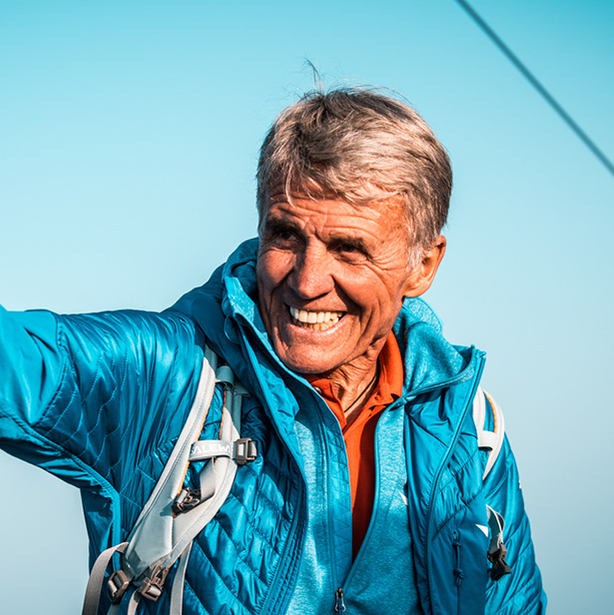
Peter Habeler was born in 1942 in Mayrhofen in the Zillertal, a valley in the Austrian Tyrol. From childhood onwards, encouraged by his grandfather following his father’s death, he roamed freely through these mountains and climbed his first peaks, such as the Olperer: thanks to Toni Volgger, a local guide, he learnt the techniques of mountaineering: “When I was ten or eleven years old, I met these mountain guides. They took me to the mountains. I was a little, tiny guy.” He decided he wanted to become a guide himself, which he did in 1965. An excellent skier, he joined the Austrian ski instructors’ training team a year later.
He made the first ascent of the south-west pillar of the Reichenspitze (3,303 m) alongside Sepp Kreidel in 1962. Graded VI (or UIAA VI-), it is regarded as one of the most demanding free-climbing routes without bolts from the early days of alpine climbing in the Zillertal and would not be repeated until more than four decades later in 2003. His meeting with the formidable Tyrolean Sepp Mayerl in 1963 enabled him to embark on his first major Alpine ascents, notably in the Dolomites (Comici on the Cima Grande, Vinatzer on the Marmolada and Philip-Flamm on the Civetta, at that time considered one of the hardest routes in the Eastern Alps.)
During the summer of 1967, together with his compatriot Michl Meier, he was invited to Chamonix by the ENSA. On this occasion, they went on to repeat, on Mont Blanc, the Bonatti–Gobbi route on the Grand Pilier d’Angle and the Pilier central du Frêney (third ascent).
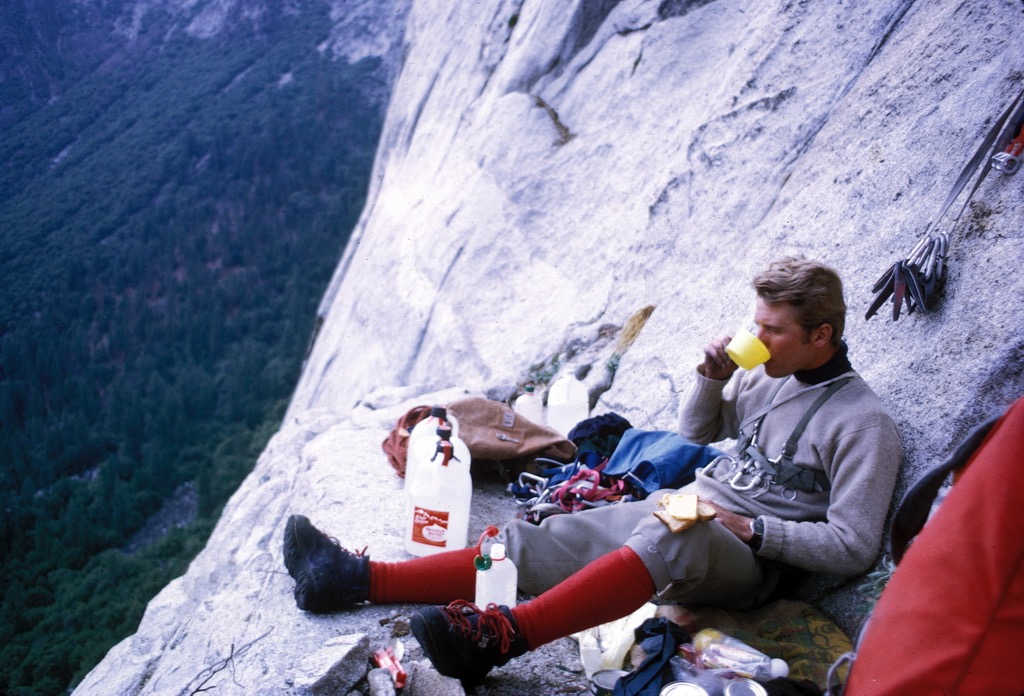
In 1970, whilst climbing the Salathé Wall (the 12th ascent) alongside the British climber Doug Scott (recipient of the Lifetime Achievement award in 2011), he became the first European to climb a big wall on El Capitan in Yosemite. It was whilst teaching skiing in Jackson Hole, Wyoming, that he met the most influential American climbers of the time, such as Yvon Chouinard, Royal Robbins and Chuck Pratt: “I was lucky enough to meet the best people in the world… They would explain their tricks to us at the foot of El Cap. Royal showed me how they went about it, and I learnt quickly.”
In 1965, Habeler had a life-changing encounter: Reinhold Messner, from the Italian part of Tyrol. Their partnership would leave a lasting mark on mountaineering during the rest of the 20th century. “To me, he was a hero,” says Messner. “I was incredibly lucky to set off with him… And then we grew closer and closer.” Each found in the other the same motivation and the same desire to follow in the footsteps of mountaineers such as Hermann Buhl and Walter Bonatti. “I saw in Messner the person I was at the time” recalls Habeler.
Having conquered the great Alpine faces, in 1969 they climbed Yerupaja Chico (6,121 m) in Peru. They had previously been forced to turn back (due to poor rock) just a few metres from the summit of Yerupajá Grande (6,635 m) after having pioneered a new, extremely difficult route up the unclimbed east face and east ridge.
The climbing team’s rise to media prominence came in August 1974. After a swift ascent of the north face of the Matterhorn, they turned their attention to the world-famous north face of the Eiger, just as Clint Eastwood was filming The Eiger Sanction there. Setting off at 5 am, they reached the Exit Cracks at 2 pm and the summit an hour later: “The highlight wasn’t the climb itself, it was meeting Clint Eastwood! He sped us up, because we knew he was watching.” In the space of 10 hours, high-level alpinism had entered a new dimension. The previous record for a rope party was 18 hours, set in 1950, and it was not until 30 years later that it was broken again (9 hours in 2004 by Stephan Siegrist and Ueli Steck)!
Applying their ‘fast and light’ and ‘by fair means’ philosophy to the highest peaks, a year later they succeeded in making the first alpine-style ascent of an 8,000-metre peak – Gasherbrum I (or Hidden Peak), 8,080 m (second ascent) – in a five-day round trip. They limited their equipment to the bare minimum, carrying only a small bivouac tent and a stove, but no technical gear or ropes, and climbing in simultaneously solo style. This was Habeler’s first experience at very high altitude: “It wasn’t that difficult. The hardest part was believing in it.” Following this success, the pair set their sights even higher: ”Gasherbrum I marked the start of an adventure which, back in 1975, we had no idea where it would take us.”
Three years later, there they were at the foot of Everest, as part of an Austrian expedition to the Nepalese side of the mountain, with this mad plan: to climb the world’s highest peak without oxygen. But Habeler had just become a father and his motivation was not quite as extreme as Messner’s. He eventually asked the other members of the expedition to join them in their attempt using oxygen, but they refused: ”I then decided to set off with Reinhold as planned, just to prove myself to the others. And all my other reservations had completely vanished. I couldn’t care less about any physical or psychological damage it might cause. I was driven solely by a blind rage that pushed me to press on! […] Even though we were incredibly close to one another and formed an inseparable whole, we agreed on one thing: if one of us were to find themselves in difficulty, the other would have to do everything possible to ensure their own safety, even if that meant abandoning the other.”
But everything went well and they became the first people to reach the Roof of the World without supplementary oxygen: “I was more afraid before the climb. As we gained altitude, it felt as though I was climbing in the Alps. I wasn’t thinking about oxygen problems; I was focused on every step I took. […] Messner and I thought it was doable if we travelled light, without heavy backpacks, and that was the key to our success: carrying nothing but a small pack and having confidence in ourselves, moving slowly, stopping, setting off again… and reaching the summit.”
After Everest, Messner invited him to join him in climbing the other peaks over 8,000 metres, but he declined, preferring to look after his family and his ski school in the Zillertal. Much later, Messner (recipient of the Lifetime Achievement award in 2010) acknowledged that “without Peter, I would not have become the person I am today.”
However, during the 1980s, Habeler returned to the Himalaya, climbing Nanga Parbat (1985), Cho Oyu (1986) and, most notably, Kangchenjunga via its north face in 1988 with the American Carlos Buhler and the Basque Martín Zabaleta. This last ascent remains one of the highlights of his career, at a time when he felt he was in the best shape of his life. On the day the team summited, Habeler set off at a blistering pace, reaching the top before his companions. A storm blew in. “I waited; there was no sound,” says Habeler. “And I knew they are gone. It was snowing heavily—you couldn’t see a thing.” Finally, he heard shouting. Buhler and Zabaleta were exhausted, but alive. Buhler had frostbitten his feet, and Zabaleta was coughing blood. The next day, Habeler struggled to find the fixed rope that would allow the trio to escape from the upper mountain. Finally, he located the line, buried beneath meters of snow. An avalanche had destroyed their third and second camps. They returned to safety by the skin of their teeth. ”Kangchenjunga is a fantastic mountain and, for me, the most difficult. I formed a very good team with Martín and Carlos. The Everest expedition was magnificent, but the Kangchenjunga one was ours alone and it has remained in my memory as the most moving.”
He remained active in the mountains over the following decades. In 2017, he returned to the north face of the Eiger with the young Austrian prodigy David Lama (1990–2019), whose mountaineering ambitions he had encouraged from a very young age. At almost 75 years old, he completed the ascent again in a single day!
Today, he still lives in Mayrhofen, climbing or skiing every day, close to his mountains: “It may sound silly and out of place, but that was the case then and it still is now. The mountain has always been my friend, never my enemy.”
©P.Habeler